

Category: Senza categoria
Dic 21
“Nothing happens until Someone sells Something” for Startups
That famous business quote, “Nothing happens until Someone sells Something,” is most famously attributed to Henry Ford, but variations exist and it’s also linked to sales leaders like Thomas J. Watson Sr. (IBM) and Peter Drucker, emphasizing that sales drive all business activity.
This is a classic business saying. It means that, no matter how great a product, idea, company, strategy, or innovation is, nothing really starts to matter financially until a sale is made.
The key elements of this thinking:
• Revenue is the engine that drives everything else.
• Design, engineering, operations, finance, and strategy are all important, but they only become sustainable when customers actually purchase the product or service.
• Sales demonstrate value: if people pay for something, it confirms that it solves a real problem or satisfies a real desire.
What does it highlight?
• It emphasizes the importance of sales teams and market validation.
• It reminds startups not to get lost in planning or building without customers.
• It also emphasizes that market execution matters more than ideas alone.
The quote has a special meaning when applied to Startups.
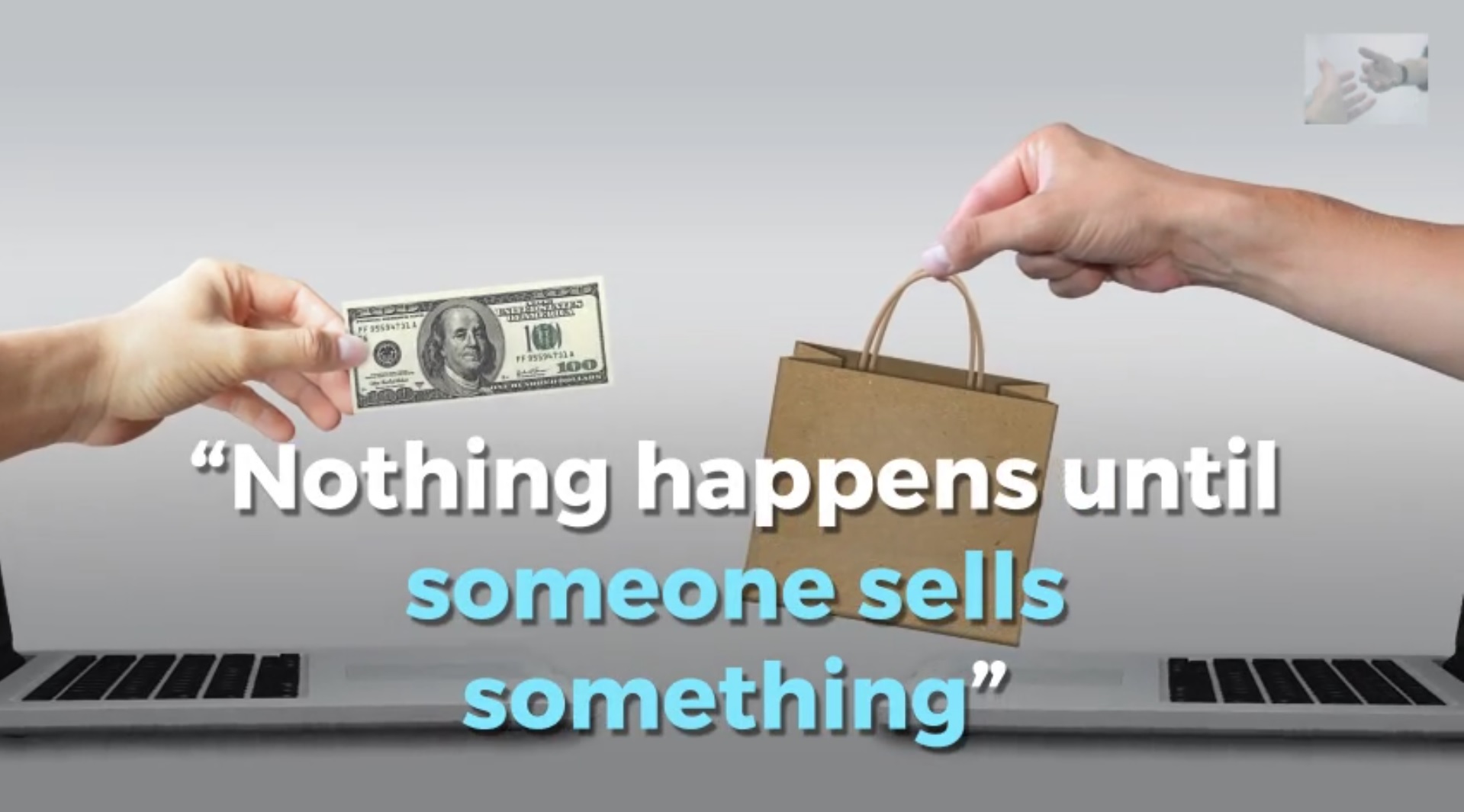
When startups fail to respect the principle “Nothing happens until Someone sells Something,” they usually fall into one or more predictable traps:
- A product obsession without concrete evidence
Startups often invest too much in creating the “perfect product” instead of seeing if anyone is willing to pay for it.
This way of thinking leads to:
- Long development cycles without real feedback
- “We’ll sell after we’re done” thoughts
- Excellent solutions to problems that no one cares about. Or aren’t interested enough to open their wallets to buy them.
Result: A waste of time and money before truly discovering whether there’s a market.
- Confusing interest with demand
Startups love to hear:
“That’s great.”
“We’d definitely use that.”
“Let me know when it’s ready.”
But these aren’t real sales. When founders don’t adhere to this principle, they count enthusiasm, beta signups, clicks, or surveys as traction… instead of revenue, contracts, or invoice collection.
Result: misplaced trust and misleading traction metrics.
- Ignoring the difficulty of selling and the importance of selling itself
Selling is really hard: positioning, pricing, negotiation, objection handling, and closing.
Many founders with technical backgrounds underestimate it because:
- It feels uncomfortable in sales
- It’s easier to build than to be rejected
- They assume that “a great product sells itself.”
But of course, this rarely happens.
Result: They delay building a sales force until it’s too late.
- Misaligned Internal Priorities
When startups don’t focus on sales:
- Product teams optimize for perfection instead of market fit
- Marketing talks about vision and image instead of focusing on lead generation
- Founders chase investors instead of customers
Result: Company energy shifts toward internal activities instead of external ones. And how external impact generates internal results.
- Poor Corporate Discipline
Adhering to the principle “Nothing happens until Someone sells Something” requires real discipline:
- Clear value proposition
- Real pricing strategy
- Understanding buyer psychology
- Evidence-based decision-making
Ignoring corporate discipline leads to:
- Vision-driven fantasy rather than executional reality
- Burn rate with no path to revenue
- The classic, dangerous “we’ll monetize later” thinking that kills companies
- Dependence on investors as a substitute for customers
If startups don’t prioritize sales, they often rely on fundraising as a lifeline.
This is dangerous because:
- Investors are not customers
- The capital raised could (temporarily) hide a weak or inadequate business model
- Eventually, the market adapts and shifts over time
Result: Founders create a company designed to pitch rather than to acquire (paying) customers.
In conclusion
When startups ignore this principle, they miss the only true validation that matters: a paying customer proves that value exists.
Sales aren’t just revenue: they’re proof of product-market fit, sustainability, and relevance.

Seal a Deal
“Nothing happens until Someone sells Something“
Leave Your Comment Here